
REVIEW · DACHAU MEMORIAL TOURS FROM MUNICH
Munich WWII and Dachau Concentration Camp Private Tour with Licensed Guide
Munich can be beautiful and heavy in the same breath. This private WWII and Dachau day pairs Munich’s Nazi-era sites with a guided visit to Dachau, so you see how power moved through streets, buildings, and people. I especially like the private hotel pickup and chauffeur-driven minivan (you start on time, no transit puzzle). I also like how the tour keeps explaining what you’re seeing, not just pointing it out. The only real drawback is that the themes are intense, and the Dachau portion needs emotional readiness.
You also get a full day without the usual logjams. With stops paced across central Munich and the outskirts, you get context for what happened and why it mattered. If you are sensitive to WWII history, or you’re traveling with kids under 12, you may want to think carefully about whether this is the right match.
Key highlights you should care about
- Licensed guide for Munich and Dachau, including a guided memorial visit at Dachau
- Private minivan pickup from your hotel or address in Munich (and return is possible), with chauffeur service
- Lots of “why this place matters” stops, from Marienplatz to Königsplatz and Maxvorstadt
- White Rose memorial coverage, including the Ludwig Maximilian University visit
- A realistic Dachau plan, with an average memorial stay of 1.5 to 2.5 hours and guidance on footwear
- Free admission listed for the stops, plus mineral water and no hidden costs
How the private format changes your Munich WWII day
This is not a quick-hit sightseeing loop. It’s built as a full narrative day, which is exactly what you want for WWII sites because so many of them depend on context.
The private part matters. Your group rides in a new VW or Mercedes minivan with air-conditioning, and you’re not sharing your time slots with strangers who might rush or wander. That means your guide can keep the pace steady and use the time you spend at each stop more effectively.
It also helps that pickup is offered from almost anywhere in Munich. You can select a start time around 8:00 a.m., 9:00 a.m., or 9:30 a.m., and you can request another time if needed. That flexibility is useful if you have train schedules, a late breakfast plan, or you want to avoid peak morning crowds around central landmarks.
Finally, there’s a practical side to this tour: mineral water is included, and the stops are laid out so you can see a lot without constant transit searching. For a 9 hours 30 minutes day, that comfort and time control are real value.
Other guided visits to the memorial site
- Dachau Concentration Camp Memorial Site Tour from Munich by Train
★ 4.5 · 5,637 reviews - From Munich: Dachau Memorial Site Day Tour
★ 4.8 · 2,723 reviews - From Munich: Dachau Memorial Site Half-Day Trip
★ 4.7 · 2,526 reviews - From Munich: Dachau Memorial Site Full-Day Tour
★ 4.9 · 1,406 reviews
Pickup, ride comfort, and the rhythm of a 9.5-hour day
You start with a pickup at your hotel or address in Munich. If your group is more than 7 people, you move in a small coach, still with a driver. Either way, the tour is designed so you begin with minimal friction: you get from your door to Marienplatz, then move through the city in a way that keeps travel time from chewing up the day.
The itinerary uses a mix of walking time and driving time, and you can feel that rhythm in the way the stops are staged. Several stops are short, often 5 to 15 minutes, because the point is to see key buildings and intersections, then move on while the story stays fresh. Other moments are longer, like the memorial time at Dachau, where the day finally turns from “seeing” to “understanding” in a much slower way.
One more practical detail: in places where you may walk a bit on rough surfaces, the tour specifically warns about footpaths with coarse pebbles at Dachau. It’s a small note, but it matters. Bring shoes you can walk in comfortably for that kind of ground.
Marienplatz to the churches: starting in the heart of old Munich
Your day begins at Marienplatz, Munich’s long-running civic center. This is one of those starts that makes sense because it’s familiar, central, and full of architecture. But the guide frames it through the Nazi-era changes, including what happened to the town hall setting. The key idea is how public spaces got repurposed and made to reinforce authority, even in places that long predated that dark era.
From there, you move to Frauenkirche. You’ll spend a short block of time here, focused on late Gothic architecture and also on destruction from Allied bombings. Reconstruction changes come into the explanation too, supported by historical images. This is a good pairing with Marienplatz because it shifts your attention from the political message in public display to the physical damage war left behind.
Then you stop at St. Michael, where the focus is on the church’s major barrel vault (the second largest in the world, per the tour info) and again, on bomb damage plus reconstruction changes, supported with historical images. These quick church stops do two jobs at once: they remind you Munich was a living city, and they show how war altered the built environment that locals depended on.
If you’re the type who likes to connect the dots, this opening sequence is a strong start. It gives you “before, during, after” framing early, so later sites land with more meaning.
The Nazi-era power look at Residenz, streets, and Ludwigstrasse views
After the churches, you go toward the grand settings and then into the more direct symbolism of Nazi power.
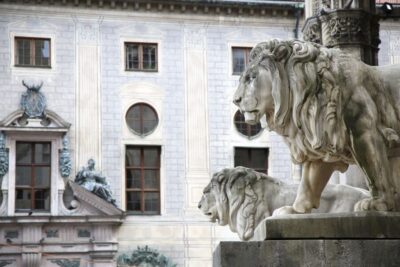
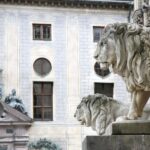
At Residenz München, you’re not there to hunt for tickets or wait in long lines. The tour frames it as a location where Nazi leadership used a spectacular Munich landmark setup for personal residence. You’ll tour the huge building complex from the outside, including mention of seven large inner courtyards, and you’ll hear about the stylistic epochs. You also get a very specific detail about the lions near the side entrances and the importance of petting one (or all) of them. It’s a small moment, but it helps break tension briefly while still staying inside the tour’s strict historical frame.
Then you get a small street stop at Viscardigasse, where your guide explains why it was called Drückebergergäßchen. This is one of those quick “Munich trivia with meaning” moments that makes a big city feel personal.
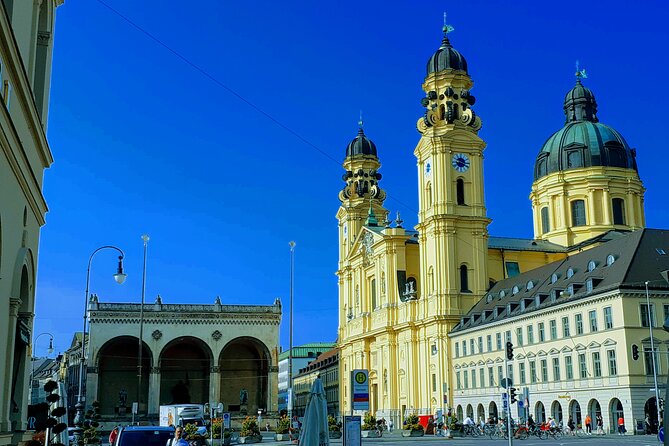
Next comes Feldherrnhalle. This stop has a turning point in the story: the attempted Hitler putsch in 1923 ended here. You’ll be at a point of view along historic Ludwigstrasse, built for King Ludwig I, and you’ll hear about how Munich’s city layout and gates connect to the event. Your chauffeur stays with you here, while other sights later are handled by minivan or coach.
That’s also a design choice. Feldherrnhalle is treated as a memory-anchor stop, not just another photo spot. If you remember one thing from the day’s Munich section, it should be this sense of place with dates attached.
The “freedom and resistance” half: NS Opfer, White Rose, and memorial time
Not every stop in this tour is designed to feel like a lecture. Some are designed to force a pause.
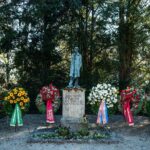
At Platz der Opfer des Nationalsozialismus, there’s an eternal flame burning in a symbolic dungeon, created in 1985 on the site of the destroyed Schiller memorial. This stop is brief, but it’s one of the clearest “remember what was taken” moments in the Munich portion. If you’re the kind of person who needs time to mentally reset, treat these minutes as yours to sit with what you’re learning.
Then you move to Ludwig Maximilian University, where the tour connects directly to the White Rose resistance group. The story includes the group’s formation after the university moved from Ingolstadt to Munich in 1826, and it names members like Hans and Sophie Scholl, Christoph Probst, Alexander Schmorell, and Willi Graf, plus Professor Kurt Huber. The tour includes a guided visit to the memorial here, with about 25 minutes allocated and admission listed as free.
This university stop is valuable because it keeps WWII history from becoming only architecture and dates. It reminds you there were people who resisted, and that resistance had consequences.
If you like tours that tell you what you’re looking at and why, this is one of the strongest parts of the day. It’s also a good place for questions, since your guide is working with a defined memorial context.
Schwabing to Hofbräuhaus: Nazi power inside everyday Munich
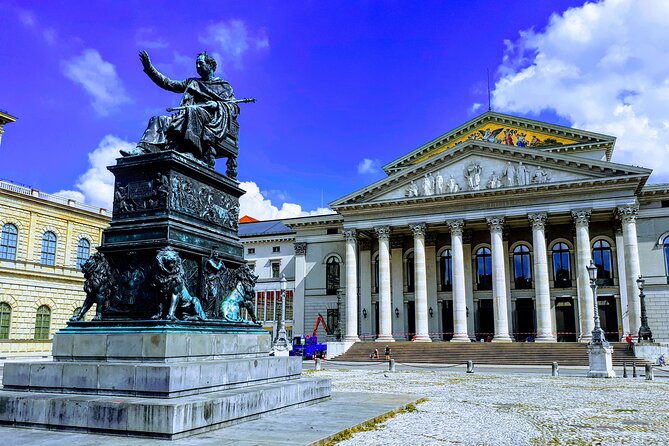
After the university, the tour shifts toward areas of Munich where everyday life and Nazi influence overlapped. You head to Schwabing, described as the former artists’ quarter and framed through places tied to Hitler, Nazi media, and even personal life. The Osteria Italiana still exists today, and the tour points to where Nazi publishing activities were located, including the editorial house Völkischer Beobachter and Heinrich Hoffmann. Verlag National Socialist Pictures. It also includes the detail that Hitler met Eva Braun in 1929 at the later Photohaus Hoffmann.
This is a crucial lesson for anyone visiting: it wasn’t all uniforms and rallies. Influence spread through media, neighborhoods, and normal routines.
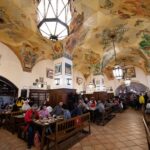
Next you spend about an hour at Staatliches Hofbräuhaus. The tour frames it through the fact that Hitler and entourage liked to meet there, and the stop gives you a practical lunch option even though lunch is not included in the tour price. You can sit on the ground floor in the Schwemme, or in the inner courtyard if the weather works. Even if you do not eat, the tour encourages you to look at the famous inn.
From a value standpoint, this is smart pacing. After earlier emotionally heavy stops and more structured memorial moments, it gives you a chance to break and reset over food. Just know you are still in a historical storyline, so don’t expect it to feel like a casual pub crawl.
Other walks through the same years

Nazi building facades, art politics, and a short mental break at Eisbachwelle
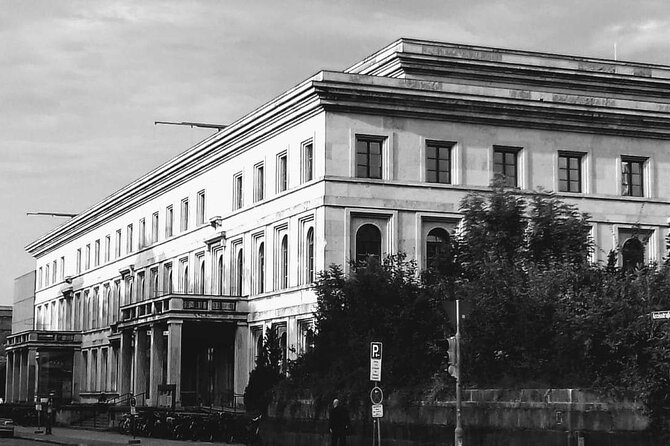
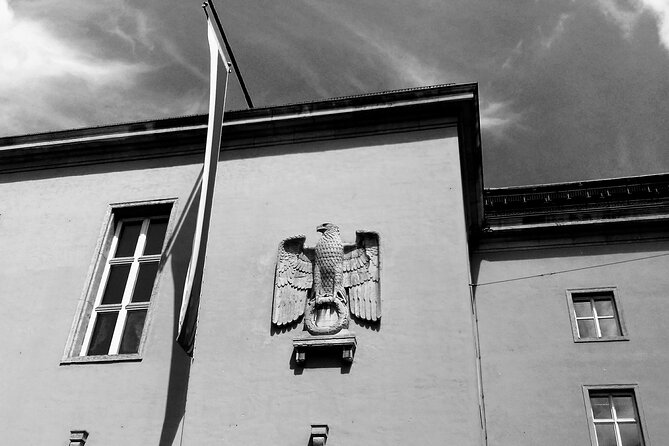
Back into architectural impact, you continue to Altstadt-Lehel, where the tour points out a monumental building from 1937 linked to Hermann Göring’s Reich Aviation Ministry. The guide calls attention to swastikas on window grilles and steel helmets on house walls, which makes the propaganda element visible right on the street.
Then comes Haus der Kunst, described as the first representative Nazi building in Munich, known in Hitler’s time as the House of German Art. Here you’ll see what the Nazi regime presented as acceptable art, with mention of swastika decoration that you can see today. This stop is short, but it hits a key theme: cultural control was part of political control.
Right after that, you get Eisbachwelle, the famous inner-city surfing spot near the site. The tour treats this as a moment to forget the horrors for a bit, because you watch surfers negotiate a standing wave that’s artificially generated. It’s a brief detour from history’s weight, and it works as a reset button before you head back into Nazi-era residential and party-center zones.
This kind of pacing matters more than you might think. A day focused on WWII can start to blur if every stop feels equally dark. One short living-city contrast helps your brain keep up.
Hitler’s housing areas and the outward face of the regime
The itinerary continues into more residential and “who lived where” territory, including Bogenhausen. The tour describes a house of Adolf Hitler in one of Munich’s noblest districts, with a 317 square meter 9-room apartment in 1929. Today it’s a police station, and it can be viewed from the outside only. You’ll also hear about Eva Braun’s villa nearby, and that the villa was demolished a few years ago.
This stop can feel unsettling because it makes the Nazi leadership feel close, not distant. You’re in a normal-looking neighborhood context, but the story is tied to power and persecution.
Then you move to Prinzregentenstraße, where the tour points out a curious Nazi-era apartment building with flanking air raid shelters, built as a model for the National Socialist upper class. The tour notes that World War II meant it was the only one completed.
Next comes Ramersdorf, where you see a Nazi model settlement. The tour says that in 1934 almost 200 settlement houses with their own gardens were built for German national comrades. It is now listed, which adds another layer to the experience: you’re looking at remnants of an ideology that still exists in the present as physical real estate.
These stops help you understand the regime as a system that shaped everyday living spaces, not just a set of speeches and battles.
White Rose deaths and Munich’s NSDAP party center at Königsplatz
Toward the later part of the Munich segment, the tour includes Stadelheimer Straße, connected to the White Rose members’ execution. In 1943, Hans and Sophie Scholl, Christoph Probst, Alexander Schmorell, Willi Graf, and Professor Kurt Huber were guillotined in the penal institution in Stadelheim. The tour also explains that their graves are located in a nearby cemetery in the Perlacher Forest.
This is not a place for light energy. It’s also where the tour’s long day starts to demand respect for your own pace.
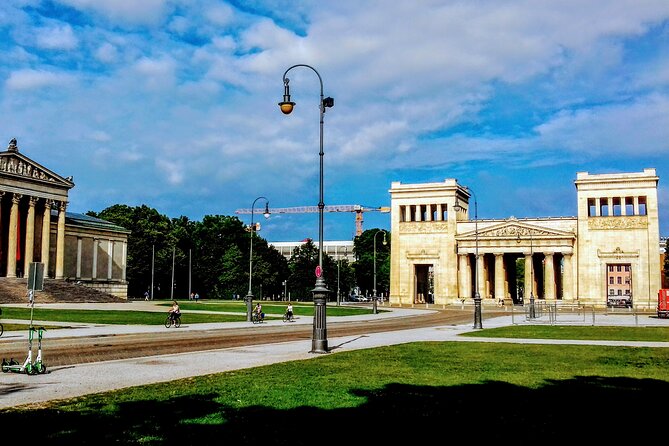
Then you move to Konigsplatz, an important historical area between Karolinenplatz and Königsplatz where the tour explains how the NSDAP party center developed, including references to the Führerbau. The tour notes that almost all Nazi buildings survived bombing attacks unscathed. It also points to the NS Documentation Center, opened in 2015 on the site of the destroyed Brown House.
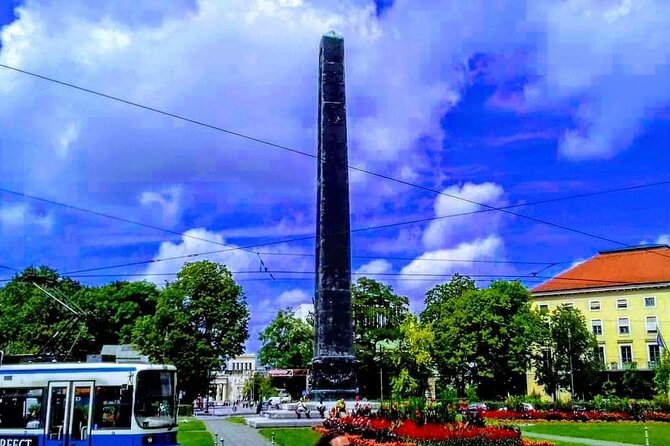
Right after that you visit Karolinenplatz, described as the center of power of the NSDAP exactly 100 years later, built around an obelisk ordered by King Ludwig I in 1833. Together, these two areas show how power used monumental scale and symbolism.
Finally, you end the Munich arc at Maxvorstadt. Here you see a now renovated apartment house where Hitler shared a shabby room with Rudolf Häusler after moving from Vienna in May 1913. The tour also points to a location of a mausoleum planned by Hitler, plus the adjoining Hall of the Party. The explanation includes a detail about Hitler being stimulated during a visit to Paris in 1940, when he reverently saw Napoleon’s sarcophagus at the Invalides.
If you’re still feeling the weight of the day, that can be a lot in one stretch. But it’s also a clear way to show how myths and symbols were manufactured.
Dachau Concentration Camp Memorial Site: what to expect and what to bring
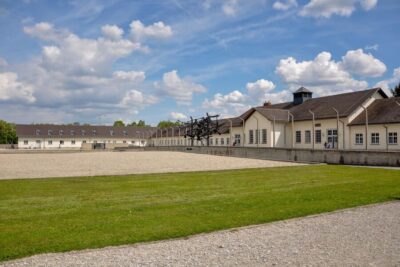
Then you arrive at Dachau Concentration Camp Memorial Site, the emotional centerpiece of the day. The tour info is blunt about the scale: over 200,000 people imprisoned over the camp’s 12-year existence, with 41,500 murdered. It’s also noted that the camp was opened just 6 weeks after Hitler was appointed Chancellor.
Before walking the memorial, the tour says you will be shown luxurious villas on the former SS grounds. That contrast is part of the point. It shows the cruelty was not only in barracks and cells, but also in the way power insulated itself from what it was doing.
Plan for time here. The tour states an average length of stay at the memorial of 1.5 to 2.5 hours. That’s not a quick tour stop. You’ll be guided, and you should treat the time as something you give, not something you rush.
Footwear matters. Some footpaths consist of coarse pebbles, so bring shoes with grip and comfort. You don’t want to spend the memorial worrying about blisters.
One more note: the tour is not recommended for people under 12 years of age. This is a respectful warning, because the subject matter is intense.
If you want the best experience, go in with the right expectations. This portion is not designed to entertain. It’s designed to witness and understand.
Price and value: what you really get for $804.18 per person
At $804.18 per person, this is not a budget tour. But you are buying a full-day private experience that includes transport, a licensed guide, and structured memorial time.
Here’s where the value comes from, based on what’s included:
- Private minivan (or small coach) with chauffeur and air-conditioning, so you spend your energy on learning, not routing
- Licensed professional guide for Munich and Dachau, which matters because the story is sensitive and detail-dependent
- Visits to Nazi buildings and memorials across Munich and the outskirts, not just a couple of photos
- Guided visit at Dachau, where interpretation and pacing matter more than speed
- Mineral water and no hidden costs, so you’re not forced into surprise spending during the day
- Mobile ticket and listed free admissions for the stops in the itinerary
Lunch is not included, so you should plan for that separately. Tips are also not included, which is normal, but it’s good to budget something if you feel the guide earn it.
The fact that this is often booked far in advance, about 249 days on average, suggests people value the format. If your dates are fixed, booking early is smart.
Who this tour fits best (and who might pass)
This tour fits best if you:
- Want a private, guided day that connects Munich locations to the larger WWII story
- Prefer structured pacing with lots of short stops plus the deeper Dachau memorial time
- Like learning from a licensed guide rather than trying to piece history together on your own
- Are comfortable with heavy subject matter and want to face it with context
You might consider another option if:
- You’re traveling with kids under 12, since Dachau is not recommended for that age group
- You want a lighter day focused only on architecture or food, because this is built around Nazi-era sites and memorials
Should you book this private Munich WWII and Dachau tour?
Book it if you want one coherent day that takes Munich beyond postcards and into the places where history happened, then finishes at Dachau with a guided memorial visit. The private pickup, chauffeur ride, and licensed guidance make it easier to keep your time organized while you handle an emotionally demanding topic.
Skip or postpone it if you know you cannot handle intense WWII material, or if your group includes young children who may not be ready for the Dachau portion.
If you decide to go, do yourself a favor: wear comfortable walking shoes, plan for a full day, and give Dachau the time it asks for. That’s where the tour’s most important message lands.
FAQ
What is the total duration of the tour?
The tour runs about 9 hours 30 minutes.
Where does pickup happen, and what time does it start?
Pickup is offered from any hotel or address in Munich at 8:00 a.m., 9:00 a.m., or 9:30 a.m. You can also request another time.
Is this tour private?
Yes. It is a private tour/activity, and only your group participates.
What kind of vehicle is used for pickup and transport?
You ride in a new, luxurious VW or Mercedes minivan with air-conditioning. If your group has more than 7 people, it may be a small coach, also with a driver.
Is the tour offered in English?
Yes, it is offered in English.
Are lunch and tips included?
Lunch is not included, and tips are not included.
Is admission included for the stops?
The tour information lists admission ticket free for the stops included in the itinerary.
How long do you typically spend at the Dachau memorial?
The average length of stay at the memorial is 1.5 to 2.5 hours.
Is the Dachau visit suitable for children?
Visiting the Dachau Concentration Camp Memorial is not recommended for people under 12 years of age.
What is the cancellation policy?
You can cancel for a full refund up to 24 hours in advance of the experience start time. Free cancellation is available.
More Tour Reviews in Munich
The Same Years, Other Routes

Other Guided Visits to Dachau
Newest Munich and Bavaria reviews
- Scenic Adventure Private Day Tour to The Konigssee Salzburg★ 4.5 · 3 reviews
- Jewish Museum & Jewish Quarter Guided Tour with Tickets★ 4.0 · 3 reviews
- Private Linderhof Castle, Entry-Ticket – optional Toboggan Run★ 5.0 · 3 reviews
- Private Transfer from Munich to Salzburg, English-speaking driver★ 3.5 · 3 reviews
- Private tour from Munich to Rothenburg and Harburg★ 5.0 · 3 reviews
- Arrival Transfer Munich Train Station to Munich by Luxury Van★ 5.0 · 3 reviews
Dachau Memorial Tours from Munich, compared.
 ★ 4.5Dachau Concentration Camp Memorial Site Tour from Munich by TrainFrom $645,637 reviews
 ★ 4.8From Munich: Dachau Memorial Site Day TourFrom $492,723 reviews
 ★ 4.7From Munich: Dachau Memorial Site Half-Day TripFrom $622,526 reviews
 ★ 4.9From Munich: Dachau Memorial Site Full-Day TourFrom $511,406 reviews
 ★ 4.5Dachau Concentration Camp Memorial Tour with Train from MunichFrom $56955 reviews
 ★ 5.0Early-Start Dachau Memorial Half-Day Tour from MunichFrom $62942 reviews
 ★ 5.0Guided Dachau Concentration Camp Memorial Site Tour with Train from MunichFrom $90920 reviews
 ★ 5.0Full-Day Dachau Concentration Camp Memorial Site Tour from MunichFrom $48897 reviews