
REVIEW · MUNICH THIRD REICH AND WWII HISTORY TOURS
Walking Tour on Resistance to Nazism in Munich
Munich hides its resistance story in plain sight. This Walking Tour on Resistance to Nazism in Munich strings together landmark exteriors and memorials, showing how people pushed back against the Nazi dictatorship in different ways. You start near Odeonsplatz and end at the Georg Elser area, with a clear, story-driven route through central Munich.
I love how the tour focuses on resistance, not just dates and buildings. I also like that the stops are designed for quick understanding, with about 20 minutes at each location, plus free admission at every stop so your money goes to the guide’s explanations. In the same spirit of helpful, human storytelling, you’ll hear names like Laura, Maca, Javier, Jaime, and Julieta tied to friendly, clear guiding and lots of chances to ask questions.
One possible drawback: the walk covers a lot of ground in a short time, so if you want to linger and read everything on your own, you may feel slightly rushed on the spots that catch your interest most. Bring comfy shoes, and plan to return to any site you want to explore deeper.
Key things to know before you go
- A focused 2.5-hour route from Odeonsplatz to Georg Elser locations, paced for learning, not marathon walking
- Free admission at all stops, so the $19.49 ticket mainly buys the guided story
- Resistance comes in many forms, from political action to art censorship to armed plots
- Major Munich sites tied to Valkyrie, the White Rose, and Georg Elser
- Small groups (max 25), which makes questions easier and the pace calmer
Where you start at Odeonsplatz, and how the 2.5 hours really feel
The tour runs at 3:00 pm and lasts about 2 hours 30 minutes. The meeting point is Odeonsplatz, and the walk finishes at Georg-Elser-Platz in the Maxvorstadt area. Since you are moving through central Munich, it helps to show up a few minutes early so you can settle in, find the group, and get oriented before the story kicks off.
You’ll be walking with a small group (up to 25 people). That matters here, because the topic is heavy and you do not want the tour to feel like a noisy rush-through. Also, it is near public transportation, which is useful if you are connecting from another stop. If you are traveling with a service animal, you can bring one along, and the tour notes that most people can participate.
What you should bring is simple: comfortable shoes, water, and a mindset that this is not a sightseeing loop. It is a guided sequence of places where Munich’s Nazi-era reality and the courage of resistance both show up. The timing also helps. A mid-afternoon start means you can still see the city in daylight, which makes it easier to connect each stop to where you are standing.
Other walks through the same years
- Munich: Third Reich & WWII Walking Tour
★ 4.6 · 6,181 reviews - Third Reich Walking Tour Munich
★ 4.5 · 4,291 reviews - Munich: Birthplace of the Third Reich Guided Walking Tour
★ 4.6 · 771 reviews - Munich World War II Sites Including Dachau Concentration Camp
★ 4.5 · 570 reviews
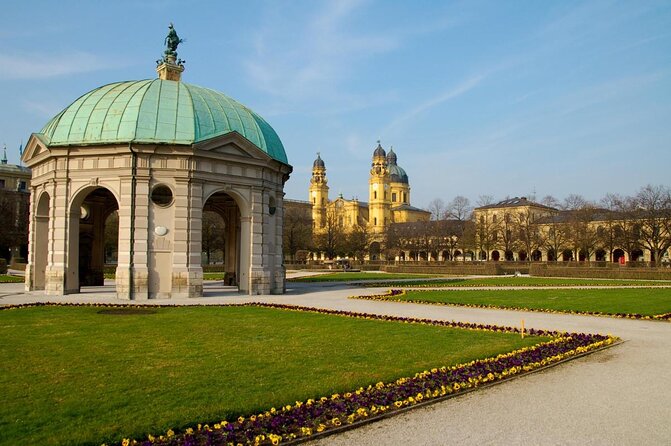
Hofgarten and Bayerische Staatskanzlei, the Nazi takeover seen through power and politics
The first stop is Hofgarten, where you talk about how the royal family lived during the Nazi period and what the political situation looked like at that moment. This is a smart way to begin because it shifts you from abstract ideas to real power structures. Instead of treating the Nazi regime as a single villain, the tour frames it as a system that reorganized daily life, including the lives of people close to the center of power.
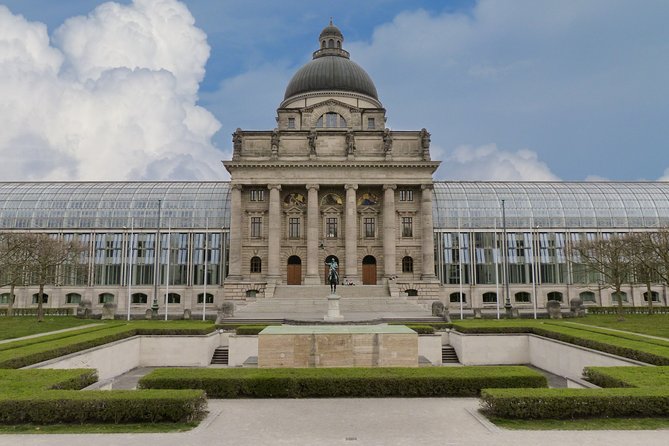
From there you move to the Bayerische Staatskanzlei (Bavarian State Chancellery). Here the story turns to how political parties resisted the Nazi regime, including the Sopade angle. Even if you know World War II history in broad strokes, this kind of political stop changes your perspective. Resistance is not only about dramatic acts. Sometimes it is about competing voices, organizations, and trying to keep opposition alive while the state tightens control.
Why this matters for you: if you arrive thinking resistance means only sabotage or underground work, you may leave with a clearer picture of how opposition could be political, public-facing, and constrained all at once. The trade-off is that these first two stops are mostly about context. You will get the storyline, but you may not yet get the visceral feeling you get later at memorials and more focused sites.
Prinzregentenstraße and the Luftwaffe command center, resistance inside the system
Next you reach Prinzregentenstraße, where the tour points you to the building that served as the former Luftwaffe Command Center. This stop is about resistance within the militia itself. That phrase matters. It tells you the tour’s main goal, to show how opposition could exist inside structures that should have been loyal.
Standing near what used to be a key military node helps you understand the uncomfortable truth behind many resistance stories: people who had access to power or influence could still choose to resist, or at least help enable resistance from within. It also makes the rest of the route feel more logical, because you are already primed for the idea that resistance was not one single track.
From a practical point of view, this is one of those stops where the exterior setting helps you build a mental map fast. That is valuable if you like being able to picture what you are hearing. The possible downside is similar to the earlier stops: about 20 minutes here means you get the big picture, not pages of detail. If you want to read deeply on your own, consider planning time after the tour to revisit the sites that grabbed you.
Bavarian National Museum and the Valkyrie Operation story
At the Bavarian National Museum, the walk focuses on the Valkyrie Operation. Even without a long museum detour, this is a strong pairing, because the tour uses the location to connect what you hear to Munich’s physical landscape. You learn about the known operation and how it fits into the wider pattern of resistance.
For me, this stop is where the tour’s tone can shift from “here is the system” to “here is the risk.” When resistance connects to an operation like Valkyrie, it stops being only theory or political opposition. It becomes a question of consequences, timing, and how much danger people were willing to accept.
Just keep expectations realistic. This is still a walking tour, with limited time at each location. You get a guided explanation, but you do not get hours of standalone study. If you love strategy and military-history specifics, you might want to do additional reading afterward so the operation story has room to settle in.
Haus der Kunst, censorship, Degenerate Art, and Nazi control of media
Then comes Haus der Kunst, and the focus moves into culture. The tour covers how Nazism tried to censor art, including references to Degenerate Art. You also cover how the regime used its propaganda apparatus and managed the press.
This is not a random art stop. It is a lesson in how control works when a dictatorship wants more than laws. It wants minds. By highlighting censorship and propaganda, the tour helps you see the Nazi regime as an engine of messaging. It does not only punish people for opposing it, it tries to reshape what society thinks is acceptable, normal, and believable.
What I like about this approach for you is that it gives balance. A history tour that focuses only on courts, prisons, or armed resistance can feel one-note. Here, you get a parallel story about culture and media, which is often easier to connect to modern life because propaganda techniques are not limited to the past.
The challenge is emotional weight. If art censorship and media manipulation hit you hard, pace yourself. Step back for a moment if you need to. A good guide will read the room and keep the tone clear, not sensational.
Ludwigskirche and the Church, Law T4, and religious resistance
At Ludwigskirche, the tour turns to the relationship between the Church and Nazism, including Law T4, and how religious people resisted the regime. This is an important stop because it addresses moral and institutional tensions, not only political ones.
Even if you already know the basic outline of Nazi policies, pairing the Church with Law T4 in a single stop is a powerful way to underline that resistance can also be about conscience and belief. You are looking at a place that represents religion in public life, and then learning how Nazi policies collided with that role.
For practical travelers, this stop can also help you process what the earlier stops began: resistance is not a single category. It can be political, cultural, religious, military, or personal. It can be overt or constrained, heroic or complicated, but it still exists.
More of the Altstadt on foot
DenkStätte Weisse Rose and the courage of student resistance
Next is DenkStätte Weisse Rose, centered on the White Rose. The tour frames them as the best-known resistance group in Munich, and that alone makes the stop feel like a hinge point in the route. Earlier moments could be about structures, offices, and operations. The White Rose stop brings it closer to individuals making choices with paper, words, and risk.
Why you’ll likely remember this part: resistance groups like the White Rose are the kind of story that sticks in your mind because the name becomes a symbol. It’s easier to tell people about after the tour. Also, it’s easier to feel the moral clarity you get when resistance is tied to refusing to accept what is wrong.
Since the tour’s time at each stop is about 20 minutes, you will probably get a clear starter picture rather than a long, text-heavy session. If this is the stop you care most about, plan a return trip later when you can slow down and read what’s on-site.
Türkenstraße and the Georg Elser Memorial, trying to stop the Führer
The final featured stop is at Türkenstraße, focusing on the Georg Elser Memorial. The tour explains the idea of being attentive against the life of the Führer himself. That phrasing captures the point: resistance sometimes meant targeting the person at the top, not just fighting a system from the edges.
Ending at this area, near Georg-Elser-Platz, creates a satisfying emotional arc. You start with power and politics, you move through institutions and operations, you cover censorship and conscience, and you land at a memorial tied directly to an attempt to change the Nazi leadership equation.
This is also where the tour’s meaning lands. You see that resistance in Munich was not only about reacting after the regime took hold. It was also about trying to prevent damage, interrupt plans, and reduce harm through action, in the way those people believed they could.
Guides make the difference, and you’ll want to catch their style
This kind of tour lives or dies by the guide. The pattern in the available guidance is consistent: people praise guides for being friendly, explaining clearly, and sharing details in a way that stays understandable. Names that come up include Laura, Maca, Javier, Jaime, and Julieta.
If you are lucky enough to have Laura, the tone described for her is warm and easy to follow, with explanations that feel interesting instead of like a lecture. Maca is described as transmitting the story from the heart, and that matters a lot here because the subject is sensitive. Javier and Jaime are noted for genuine interest in history and for making the tour feel enjoyable and engaging, not stiff. And Julieta is paired in suggestions as a strong guide option too.
What you should do: come with one or two questions. For example, ask how the different forms of resistance connected in real life, political action versus cultural censorship versus armed plots. When the guide has time to answer, the whole route clicks together.
Price and value: why $19.49 can feel fair here
The price is $19.49 per person, and it is set up as a guided walk rather than a museum pass. For 2.5 hours and a route that includes multiple major stops, it can feel like good value, especially because the tour notes admission tickets are free at the stops.
That free-admission detail is not just a perk. It changes the math. You are paying for interpretation, pacing, and context, not for separate entries that would stack up quickly. And since the group is capped at 25 people, you are not stuck in a huge crowd where the guide can barely be heard.
One more value point: the tour uses a mobile ticket, which cuts down on paper fuss. And because it is often booked well ahead on average (141 days), it tends to sell out in peak times. Booking early is a smart move if you want the 3:00 pm slot.
Who should book this Munich resistance walking tour
Book this if you want:
- A guided, map-based understanding of resistance across Munich locations
- A route that covers political action, military-linked resistance, cultural censorship, church tensions, and named resistance groups
- A structured introduction you can build on later with your own reading
You might think twice if:
- You hate walking for 2.5 hours in one go
- You want slow, detailed museum time at each site, because each stop is about 20 minutes
- You prefer only one narrow slice of history, like only art or only military events
Also, be ready for emotional subject matter. This tour is about terror and defiance. It is not meant to be light entertainment.
Should you book it, or mix it with something else?
My take: if this is your first trip to Munich and you want the city’s story beyond postcard landmarks, this is an efficient way to learn about resistance against Nazism while you physically move through the city. It is also a good complement to a general Munich walking tour, because it gives you a specific theme and a sharper lens.
If you already know a lot and crave deep reading inside each place, you can still book it for the structure, then spend extra time after the tour at your favorite stop. But if you want a single guided hit of context, this one makes a strong case.
FAQ
Where does the walking tour start and finish?
It starts at Odeonsplatz (Odeonspl., 80333 München) and ends at Georg-Elser-Platz (80799 München-Maxvorstadt).
What time does the tour begin, and how long is it?
The start time is 3:00 pm, and the duration is approximately 2 hours 30 minutes.
How much does the tour cost?
The price is $19.49 per person.
Do I need a mobile ticket?
Yes, the tour features a mobile ticket.
Are there admission fees at the stops?
Admission tickets are listed as free for the stops included on the tour.
What is the maximum group size?
The tour has a maximum of 25 people.
Is the meeting area near public transportation?
Yes, it is near public transportation.
Are service animals allowed?
Yes, service animals are allowed.
When will I receive confirmation after booking?
Confirmation is received at the time of booking, unless you book within 16 hours of travel, in which case confirmation is received as soon as possible based on availability.
What is the cancellation policy?
Free cancellation is available. You can cancel up to 24 hours in advance for a full refund.
More Tours in Munich

More Tour Reviews in Munich
The Same Years, Other Routes


Newest Munich and Bavaria reviews
- Scenic Adventure Private Day Tour to The Konigssee Salzburg★ 4.5 · 3 reviews
- Jewish Museum & Jewish Quarter Guided Tour with Tickets★ 4.0 · 3 reviews
- Private Linderhof Castle, Entry-Ticket – optional Toboggan Run★ 5.0 · 3 reviews
- Private Transfer from Munich to Salzburg, English-speaking driver★ 3.5 · 3 reviews
- Private tour from Munich to Rothenburg and Harburg★ 5.0 · 3 reviews
- Arrival Transfer Munich Train Station to Munich by Luxury Van★ 5.0 · 3 reviews
Munich Third Reich and WWII History Tours, compared.
 ★ 4.6Third Reich & WWII Walking TourFrom $316,181 reviews
 ★ 4.5Third Reich Walking Tour MunichFrom $454,291 reviews
 ★ 4.6Birthplace of the Third Reich Guided Walking TourFrom $29771 reviews
 ★ 4.5Munich World War II Sites Including Dachau Concentration CampFrom $105570 reviews
 ★ 5.0Munich City Walking Tour, includes Third Reich & ViktualienmarktFrom $31458 reviews
 ★ 4.5Third Reich & WWII Walking TourFrom $35417 reviews
 ★ 4.9Munich 3-Hour Segway Tour: Nazi Munich & Royal ArchitectureFrom $91194 reviews
 ★ 5.0Dachau Concentration Camp Memorial Site And Third Reich Day Tour From MunichFrom $145185 reviews