
REVIEW · MUNICH THIRD REICH AND WWII HISTORY TOURS
Inside the Third Reich (Private Tour)
Munich has Nazi history in plain sight. This private tour links key sites tied to the Third Reich, with Curt Milburn guiding you street by street and an iPad loaded with photos and film clips to help you see what textbooks often miss. Marienplatz to Residenz München becomes a clear, walkable story of how power rose, how it spread, and how it finally cracked.
I especially like the private format. Your group has the space to ask questions as you go, instead of packing everything into a single lecture moment. I also like the use of visuals, Curt hands you an iPad with hundreds of images and films, including material spanning more than 1000 years of European history, so the buildings and details land in your brain fast.
One thing to consider: this route is short, but the subject matter is heavy. You should be ready for uncomfortable parts of history, and expect mostly outdoor walking for the full 2 to 3 hours.
Key takeaways
- Private, question-friendly pacing that lets you steer the discussion as you learn
- Curt Milburn’s iPad visuals that make architecture and war damage easier to read
- A tight Munich route that connects major moments from Hitler’s rise to resistance and aftermath
- Concrete street-level evidence, including visible war damage and specific memorials
- Stops with free admission at the listed sites, so you focus on the story, not ticket hassles
Curt Milburn and the iPad Visuals: Learning That Sticks
This is a tour built around seeing. Curt Milburn runs it like a friend who knows the city deeply, then adds structure so you can follow the story without getting lost. A big part of the value is the iPad, because it does two jobs at once: it helps you interpret what you are looking at now, and it fills in what used to be there.
When you stand in Munich on today’s sidewalks, the past can feel slippery. One building looks like any other. One square just looks like a place to pass through. Curt’s iPad screens help fix that problem. You get films and images you can compare to what you see in real time, which makes the details more than “interesting facts.” It turns them into a map in your head.
From the reviews, you also get a sense that Curt’s style is interactive. People highlight how he answers questions and adapts to the pace you want. That matters on a tour like this, because it is not just about facts. It is about interpretation, motives, and cause and effect. If you like asking why something happened, you will likely feel comfortable doing it here.
One more thing: Curt is described as having professor-level command and lots of anecdotal material. That is a nice mix, because it keeps the tour from turning into dry dates. You are walking through real locations, but you are also getting the human side of politics and propaganda, including who said what and how crowds responded.
Other walks through the same years
- Munich: Third Reich & WWII Walking Tour
★ 4.6 · 6,181 reviews - Third Reich Walking Tour Munich
★ 4.5 · 4,291 reviews - Munich: Birthplace of the Third Reich Guided Walking Tour
★ 4.6 · 771 reviews - Munich World War II Sites Including Dachau Concentration Camp
★ 4.5 · 570 reviews
Starting at Marienplatz 18: Where the Story Gets Its Bearings
You meet at Marienplatz 18, 80331 München, and the tour starts at 10:30 am. That location matters because Marienplatz puts you at the heart of Munich’s public life. It is an easy place to find, and it is a good starting point for orientation.
The tour runs for about 2 to 3 hours, and it ends back at the meeting point. That loop is part of what makes this feel manageable. You are not signing up for an all-day endurance test. You are signing up for a focused walk where each stop is chosen to connect to the next.
You also get a sense of how the timing works on the ground. Many stops are around 10 to 20 minutes. That forces good priorities. You do not just stop to take a photo and move on. You stop long enough to understand what you are seeing, then you move on before your attention fades.
Also, the experience notes say mobile ticket. In practice, that usually means less fuss. You show your ticket on your phone instead of hunting for something to print.
Finally, it is listed as near public transportation, and service animals are allowed. Most people can participate. So even if you are not a hardcore walking person, this format is likely more realistic than longer, spread-out tours.
Isartor Beer Hall Site: The Early Meeting Points of Nazis
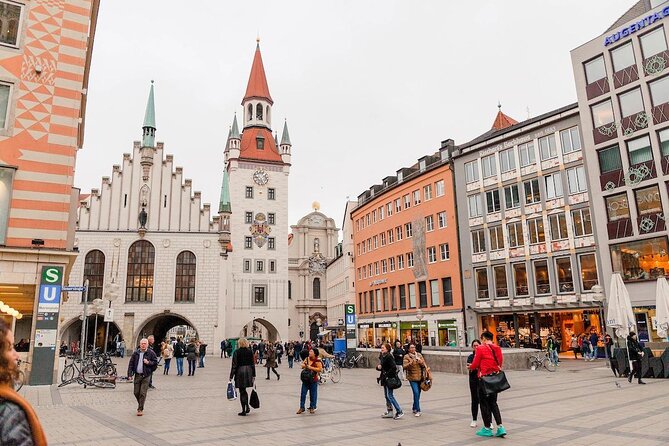
The first stop is Isartor, described as the original beer hall where Hitler met the Nazis. This is where the tour starts moving from architecture into intention.
Beer halls in Munich were not casual party spaces. They were political stages. So when Curt takes you to Isartor, you are not just learning a name. You are stepping into the kind of place where propaganda could spread fast, where crowds could be swayed, and where political networking could happen in plain view.
A key advantage of starting here is that it sets your frame. You begin with the idea that the Third Reich did not appear fully formed. It grew out of meetings, relationships, and public performances. That makes later stops click, especially when you reach the squares and speech locations tied to Hitler’s rise.
Drawback to consider: because the tour is short, you need to listen closely right at the beginning. The story is building momentum. If you show up distracted or you are thinking only about photos, you might miss the thread Curt is knitting together.
Platzl: First Speeches, Then Evidence of War Damage
You hit Platzl in two different moments, and the contrast is one of the smartest parts of the route.
First, Platzl is where Hitler’s first speech is tied to the site, and where the narrative points to his rise to success. The point here is progression: you see how something begins as a public performance and then gains traction. Curt’s commentary helps you understand the mechanics of influence, not just the fact that a speech happened.
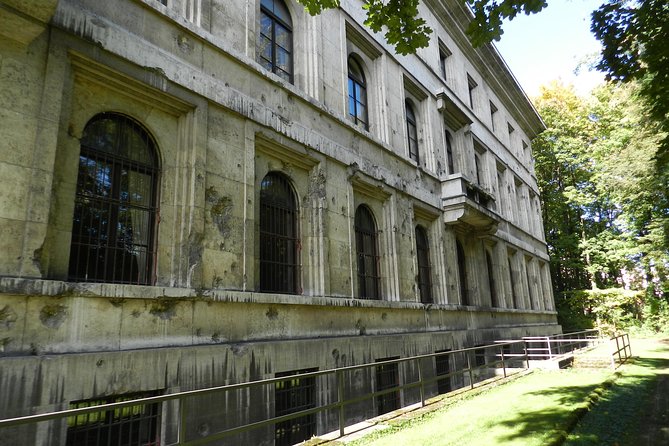
Later, you return to Platzl to look at evidence of war damage on the beautiful buildings of Munich. That shift changes the emotional temperature of the walk. It is no longer about ambition and crowds. It is about what the conflict cost, and how it scarred the city.
This is one of the places where the iPad likely matters most. War damage is sometimes subtle from far away. Even when damage is visible, context is everything. Curt’s visuals help you notice what you might otherwise gloss over.
Old Town Hall and Kristallnacht: From Plot Attempts to Pogroms
At Old Town Hall, you get two linked story beats: the beginning of Kristallnacht, and the location of an assassination attempt on Hitler’s life.
That pairing is intense, and it is also historically meaningful. Kristallnacht is often discussed as a turning point, but it can feel abstract without a location and a sense of immediacy. Here, you are tying policy and violence to a specific civic space, which makes it harder to treat as a distant historical rumor.
The assassination attempt also helps you see the Third Reich as something opposed and contested, even if that opposition was crushed or redirected. It complicates the simplest story of a smooth climb to absolute power.
One practical tip for this stop: expect questions. Topics like assassination attempts and mass violence can spark immediate curiosity, and the experience is designed for Q and A. If something feels unclear, ask. Curt is set up to answer and keep it grounded in what the sites mean.
Odeonsplatz: The SA Purge and Hitler’s Public Stage
Next up is Odeonsplatz, tied to Hitler’s purge of the SA and to the location of speeches. This stop is a reminder that political theater often runs on two tracks at once: spectacle and suppression.
A purge is not just a behind-the-scenes event. It has a message. It signals who is safe, who is not, and what kind of “order” will be enforced. With speeches in the same general sphere, you can start to see how power consolidates itself through both intimidation and performance.
The Odeonsplatz stop also gives your brain a scale shift. In earlier stops, the focus is on the emergence of influence. Here, the focus becomes control. The tour’s design makes sense because you are moving from origin points to mechanisms of domination, without losing your way.
Private guides in Munich

Memorial on Platz der Opfer des Nationalsozialismus: The Human Cost
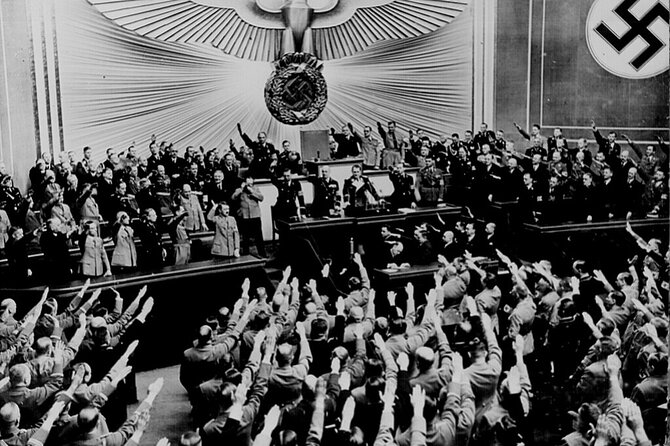
At Platz der Opfer des Nationalsozialismus, you stop at Munich’s memorial to those who died at the hands of the Third Reich. This part is not about politics as strategy alone. It is about people who were destroyed.
This stop balances the tour. Without it, it would risk reading like a list of sites tied to leaders and events. Memorials change how you feel about the rest of the route. They pull you out of the “how did they do it” mode and into the “what happened to victims” mode.
If you like quiet reflection breaks during tours, this is where it fits. You do not need to rush. You can take a moment to let the weight of the theme settle before you continue.
Glyptothek and Alter Botanischer Garten: Still-Standing Fascist Buildings and Nazi Symbols
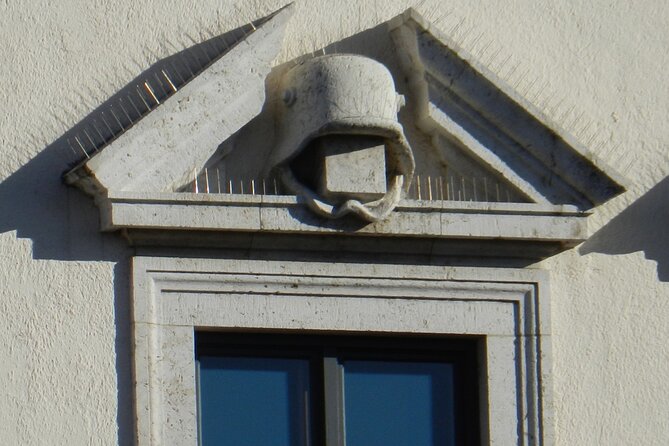
This tour gets particularly visual in the later stops, and it is here that the architecture becomes harder to ignore.
Glyptothek rally grounds and surviving fascist buildings
At the Glyptothek, you learn about Munich’s rally grounds and about fascist buildings connected to Hitler that still stand. The phrase still standing is important. It means you are not just studying what is gone. You are looking at remnants, and you are learning to read them with new eyes.
This is where the iPad can help you connect lines in the present to intent in the past. Without visuals and commentary, it is easy to see “old buildings.” With them, you see “old buildings with messages.”
Alter Botanischer Garten and the largest Nazi Eagle on public display
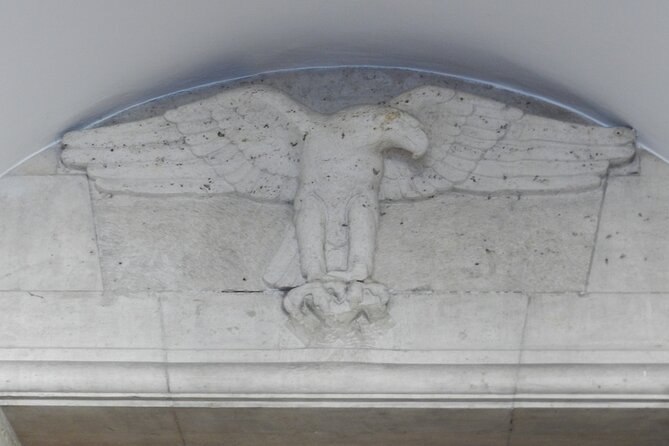
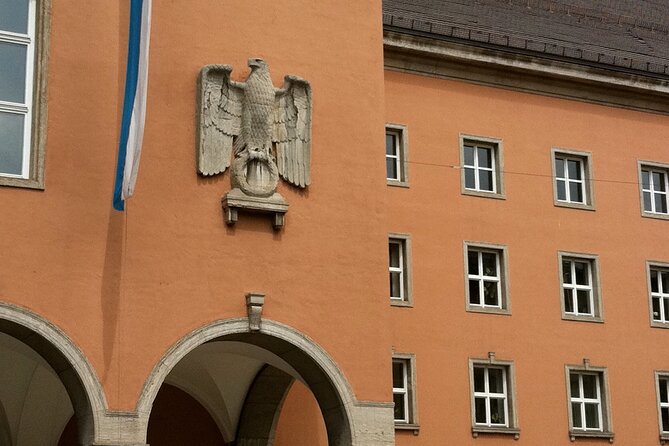
Then you go to Alter Botanischer Garten, described as the largest Nazi Eagle still on public display in Germany, along with evidence of Nazi architecture and art.
Seeing a symbol like that in person can feel strange, even if you know the history already. The tour’s value is that it does not treat the symbol like a trivia clue. It places it in an artistic and architectural context, so you understand how the Third Reich used imagery to project authority.
This stop might be the most emotionally challenging on the walk. If you prefer tours that stay at a distance, you might find this part harder. But if you want the truth of how propaganda sat in everyday public spaces, this is exactly the kind of place to see it.
Residenz München: The Failed Putsch and Stories of Resistance
The final stop is Residenz München, tied to Hitler’s failed putsch and to the story of resistance during the Third Reich.
This is a strong way to end, because it moves the narrative away from pure rise and spectacle. By the time you reach Residenz, you have seen the public stage, the suppression themes, the memorial weight, and the visual symbols. Then you close with an angle that many casual history tours skip: resistance and the reality that opposition existed.
Even if resistance did not stop the machinery in time, the point is that history is not only winners and propaganda. There were people pushing back, arguing, surviving, and leaving traces that matter.
Ending here also makes the route feel complete. You are not just watching an origin story. You are watching power attempt control, and you are learning where it met resistance.
Price and logistics: Is $180.72 per group good value?
The price is listed as $180.72 per group for up to 15 people. That is worth analyzing in plain terms.
If you are traveling as a small group, private tours can feel expensive because per-person costs rise quickly. But because this is priced per group, the math improves fast as the group size increases, and you still keep the benefit of privacy. You also get a format designed around your questions, so it feels like you are paying for access and clarity, not just walking.
Duration is about 2 to 3 hours, which helps too. There is no half-day sprawl. You are buying focus.
The itinerary lists admission ticket free at each stop, so you are not layering extra entry fees on top of the guide cost. That makes the price easier to plan around.
One more detail that affects value: the tour uses a mobile ticket, and it starts and ends at the same central meeting point. For many people, that reduces hassle and stress, especially when you are juggling jet lag or trying to fit history into a tight itinerary.
Finally, the experience notes that it is often booked about 66 days in advance on average. That is not a rule, but it is a sign you should not assume availability last minute, particularly if you want a specific day.
Who this tour fits best (and who might prefer a different pace)
This tour is a great match if you:
- care about history tied to real places, not just names in a textbook
- like asking questions during the walk
- enjoy learning through visual context, especially when you are trying to read architecture and public symbols
- want a structured, short route that still covers a wide range of themes, rise, violence, damage, memorials, and resistance
It may be less ideal if you:
- want a light, casual city stroll
- get overwhelmed by heavy topics and prefer a gentler pace
- dislike outdoor walking in a tight time window
Because the stops are relatively close and time per stop is limited, this tour also works well if you only have a morning slot and you want maximum meaning per hour.
Should you book Inside the Third Reich?
If you want a Munich walk that connects propaganda, violence, and lingering physical evidence to specific places, this is an easy yes. The biggest reasons are the private Q and A format and the iPad visual support, which help you interpret what you see without turning the day into a memorization test.
My only caution is topic intensity. Go in with the right mindset. This is not entertainment. It is a guided way to understand how the Third Reich operated and how its impact shows up in Munich even now.
If that kind of learning is your thing, book it, and give yourself time afterward to process what you saw.
FAQ
How long is the Inside the Third Reich private tour in Munich?
It runs about 2 to 3 hours.
How many people are in the private group?
It is a private tour, limited to your group, with pricing listed for up to 15 people.
Where do we meet for the tour?
The meeting point is Marienplatz 18, 80331 München, Germany, and the tour ends back at the meeting point.
Do I need a printed ticket?
No. It uses a mobile ticket.
Can I bring a service animal?
Yes, service animals are allowed.
What is the cancellation policy?
You can cancel for free up to 24 hours in advance for a full refund. If you cancel less than 24 hours before the start time, the amount paid is not refunded.
More Tours in Munich

More Tour Reviews in Munich
The Same Years, Other Routes

Newest Munich and Bavaria reviews
- Scenic Adventure Private Day Tour to The Konigssee Salzburg★ 4.5 · 3 reviews
- Jewish Museum & Jewish Quarter Guided Tour with Tickets★ 4.0 · 3 reviews
- Private Linderhof Castle, Entry-Ticket – optional Toboggan Run★ 5.0 · 3 reviews
- Private Transfer from Munich to Salzburg, English-speaking driver★ 3.5 · 3 reviews
- Private tour from Munich to Rothenburg and Harburg★ 5.0 · 3 reviews
- Arrival Transfer Munich Train Station to Munich by Luxury Van★ 5.0 · 3 reviews
Munich Third Reich and WWII History Tours, compared.
 ★ 4.6Third Reich & WWII Walking TourFrom $316,181 reviews
 ★ 4.5Third Reich Walking Tour MunichFrom $454,291 reviews
 ★ 4.6Birthplace of the Third Reich Guided Walking TourFrom $29771 reviews
 ★ 4.5Munich World War II Sites Including Dachau Concentration CampFrom $105570 reviews
 ★ 5.0Munich City Walking Tour, includes Third Reich & ViktualienmarktFrom $31458 reviews
 ★ 4.5Third Reich & WWII Walking TourFrom $35417 reviews
 ★ 4.9Munich 3-Hour Segway Tour: Nazi Munich & Royal ArchitectureFrom $91194 reviews
 ★ 5.0Dachau Concentration Camp Memorial Site And Third Reich Day Tour From MunichFrom $145185 reviews
Listed under