
REVIEW · MUNICH THIRD REICH AND WWII HISTORY TOURS
Walking Tour on Origins of Nazism in Munich – English
You’ll walk the streets tied to a dark origin story. This English guided route connects major Nazi-era turning points to specific Munich landmarks, from early party foundations to the built setting of the Third Reich. I like how it keeps the focus on understanding the why behind the rise, not just sightseeing.
Two things I especially like: you start at a memorial space for victims, and that instantly sets a serious tone. I also like that the tour mixes stops that are still in use today, like the Hofbräuhaus and Haus der Kunst, so the past is not stuck in a textbook.
The main drawback to watch for is time. Two hours moves fast for a subject this heavy and complex, so you may want a follow-up museum visit after.
Key highlights you should know before you go
- Victims-first start at Platz der Opfer des Nationalsozialismus helps keep the context grounded
- Real buildings with real purpose, like the Hofbräuhaus and Haus der Kunst, show how power used everyday space
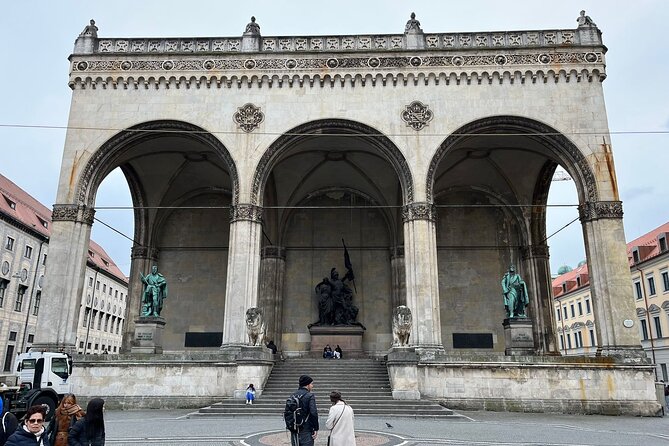
- Big-city squares and planning at Odeonsplatz and Königsplatz reveal how the Third Reich tried to shape public life
- A guided expert interpretation that aims to answer your questions about Nazism and consequences
- Some entries are included, so you can focus on learning instead of ticket logistics
Munich’s streets, the origins of Nazism, and why it matters
Munich is where the Nazi story took a decisive turn from fringe movement into a political machine. This walking tour is built around that same idea, showing how power took shape in recognizable city spaces.
What I like about approaching it this way is that you stop thinking of Nazism as a distant event in a distant place. You start seeing it as something organized, planned, and carried into public life.
This is not light content. Expect a serious, historically grounded route, with time spent at places dedicated to victims and resistance as well as sites linked to Nazi activity.
Other walks through the same years
- Munich: Third Reich & WWII Walking Tour
★ 4.6 · 6,181 reviews - Third Reich Walking Tour Munich
★ 4.5 · 4,291 reviews - Munich: Birthplace of the Third Reich Guided Walking Tour
★ 4.6 · 771 reviews - Munich World War II Sites Including Dachau Concentration Camp
★ 4.5 · 570 reviews
Your 3:00 pm plan: start at Marienplatz’s Mariensäule and end at Königsplatz
The tour runs for about 2 hours, starting at 3:00 pm. You meet at Mariensäule (Marienplatz 22) and finish near Königsplatz (Königsplatz 1).
It’s designed as a practical city walk: central locations, near public transportation, and a group cap of 35 travelers. That size usually keeps things manageable, with enough attention from the guide for questions, without feeling like a private lecture.
You get a mobile ticket, and you should receive confirmation at booking. With a time window this short, I’d plan your day so you are not rushing through other major sights right before.
Stop 1: Platz der Opfer des Nationalsozialismus and the tone-setting memorial
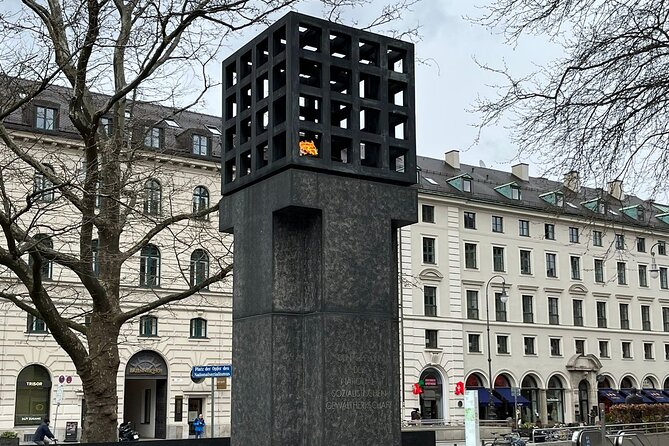
You begin at Platz der Opfer des Nationalsozialismus (Square of the Victims of National Socialism). The visit is short, about 15 minutes, and it’s free to enter.
Starting here matters. Before you look at party headquarters or propaganda-adjacent buildings, you are reminded that the Nazi system was built on violence and harmed real people. It makes the rest of the walk feel more accountable.
If you want to get the most from this first stop, give it a real minute. Read the space, slow down, and let the guide’s framing land before you move on.
Stop 2: Staatliches Hofbräuhaus, the brewery that served as a base
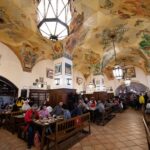
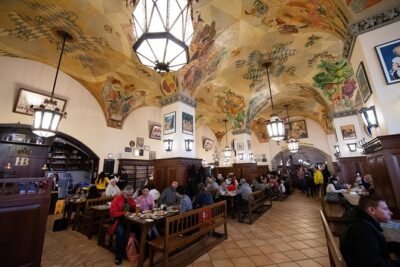
Next you head to the Staatliches Hofbräuhaus, described as the mother of all breweries, and also tied to where the Nazi party established its base. The stop is around 15 minutes, and admission is included.
I know it can sound surreal at first. A famous brewery is not the first place you imagine when learning about Nazi origins. But that contrast is exactly the point of this tour: extremist movements did not only operate in hidden corners. They worked within mainstream spaces.
For this stop, the value is in the explanation. You are not just looking at an iconic building, you are connecting it to the early phase of Nazi organizing in Munich and the party’s path to wider influence.
Stop 3: Haus der Kunst, from a propaganda building to a current museum
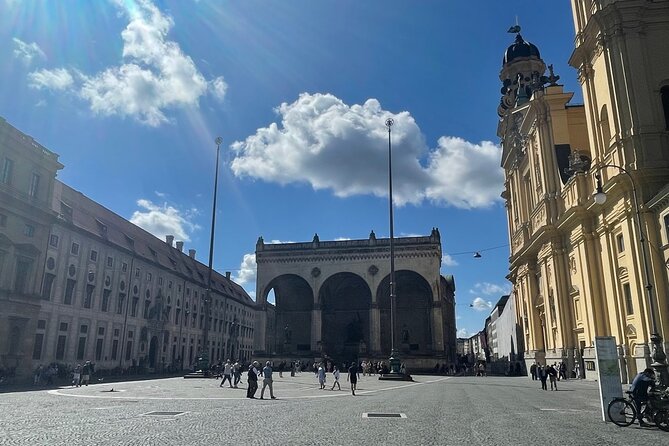
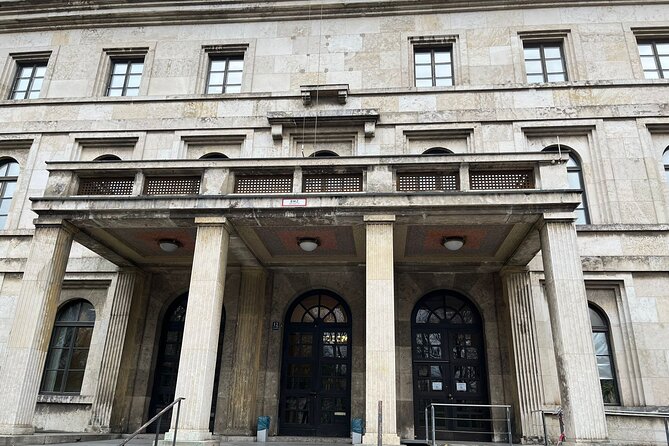
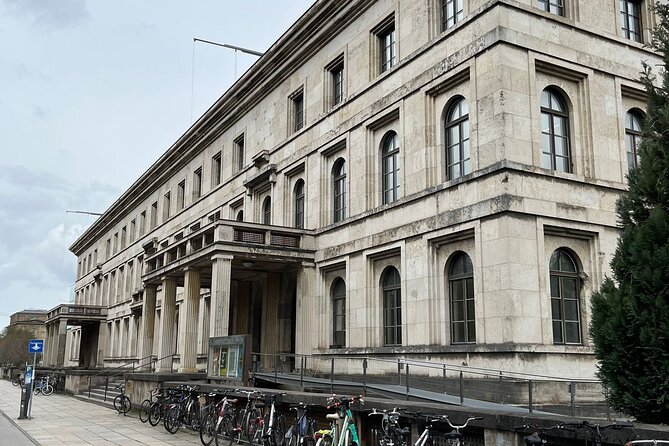
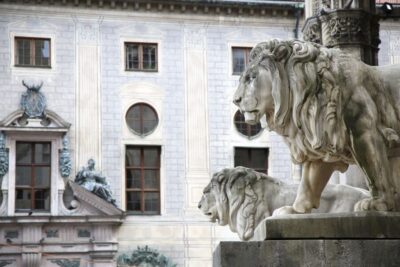
Your third stop is Haus der Kunst. It’s a current museum now, but it is also described as the first propaganda building of the Third Reich. Admission is included here, and the stop is about 15 minutes.
This is a great stop for understanding how the Nazi regime used architecture and cultural presentation. The building still exists, and because it is used today, you can compare what the space communicates now versus what it was meant to communicate during the Nazi era.
One practical note: museum buildings often have a different pace than outdoor squares. If you find yourself wanting more time to read and absorb, that is a sign this tour is best as the fast, guided orientation step, not the only learning step.
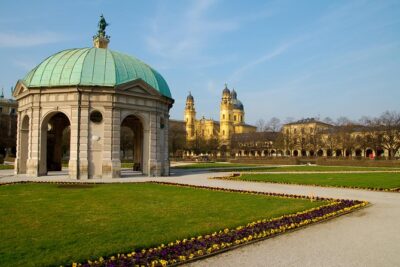
Stop 4: Hofgarten, Munich’s major park and how ideology used public space
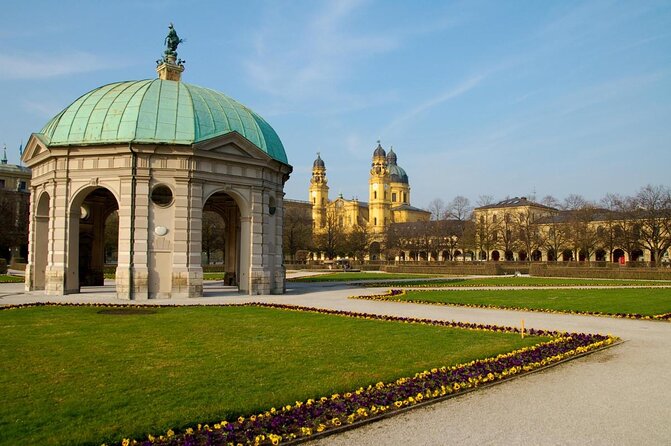
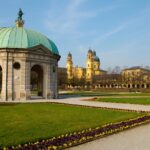
Then you move to Hofgarten, one of the most important parks in Munich. This stop takes about 20 minutes, and admission is included (per the tour details).
Parks seem harmless compared to memorials and propaganda sites, but public space is never neutral. The tour’s framing helps you notice how regimes and movements shape how people move, gather, and experience the city.
Here, I recommend paying attention to the guide’s links between space and meaning. The more you understand about how power tried to create visibility and order in public life, the more this stop makes sense.
More of the Altstadt on foot
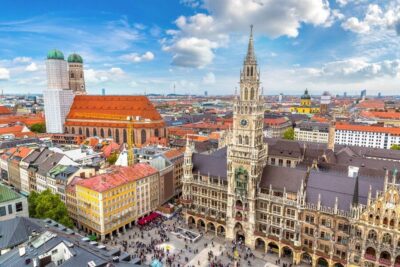
Stop 5: Odeonsplatz, a key Munich square tied to the national story
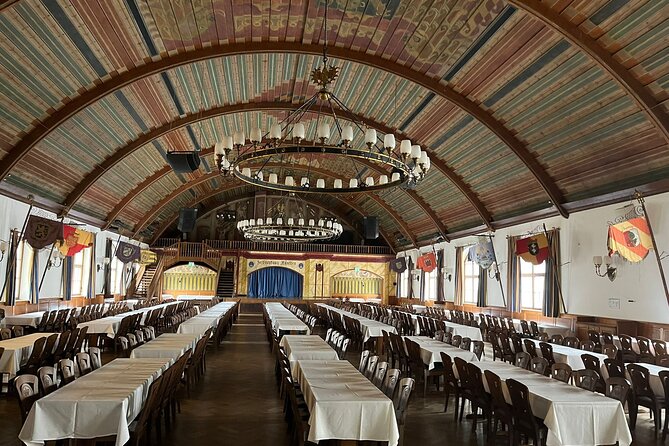
You then reach Odeonsplatz, described as one of Munich’s most important squares. This is about 15 minutes, and it has free entry.
Odeonsplatz is the kind of space where history feels large even when you do not know the details yet. With a guided tour, that changes. The explanation connects the square to the wider story of how the Third Reich presented itself in ceremonial public settings.
This stop is also a good checkpoint. After memorials, a base location, and a propaganda building, you get to step back into a wider urban view, and you can ask yourself what you are learning about political staging.
Stop 6: Königsplatz and the Third Reich’s urban backbone
The last stop is Königsplatz, one of the main squares that formed the backbone of a new city designed by the Third Reich. The stop is about 15 minutes, with free entry.
This is where the tour’s “built environment” idea comes into full focus. If you remember only one thing, remember this: symbols and structures were part of the regime’s strategy.
Since the tour ends at Königsplatz, you are set up for an easy next step. If you want more context, you can continue exploring the area on your own or connect to other Munich sights without backtracking.
What you actually learn in 2 hours (and what you might want to add)
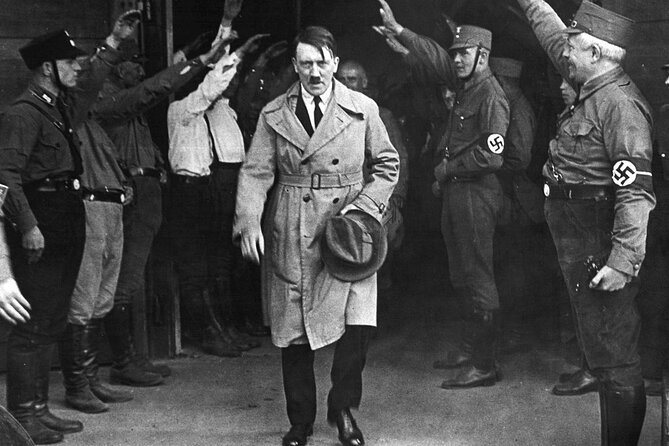
The tour’s theme is the origins of Nazism and how events helped the Nazi party grow in Munich. It highlights how Adolf Hitler was sent to Munich to spy on the German Workers’ Party, and how that early involvement became leadership and a transformation into the Nazi party. The tour also points to major, disturbing episodes often associated with Nazi consolidation, including Hitler’s coup attempt, the burning of Goebbels’ books, and the night of broken glass.
It also covers the meaning of Nazism and its consequences, and it includes references to monuments dedicated to resistance and victims. In practice, that means the guide should be working to keep the story both specific and morally clear.
Still, two hours is a tight squeeze for this subject. The route is substantial, with six stops and different kinds of spaces, so the pacing is necessarily brisk. If you are the type who wants more background reading at each site, you will likely want to follow up.
That follow-up can be simple. Use this walk to get your bearings. Then pair it with a museum visit or independent reading afterward so the timeline and ideology stick in your mind.
Price and value: $20.16 for an expert-led orientation
At $20.16 per person, this tour is priced like a strong entry ticket into a complex topic. What makes it feel like value is the mix of an expert guide plus stops that sometimes include admissions, instead of only exterior viewing.
You also get a mobile ticket, free entry at some stops, and included entry at others. That matters because it reduces friction. With only two hours on the clock, you do not want to waste time figuring out what to buy and where.
One thing to watch is that you might not feel “finished” when the tour ends. The subject is broad, and the tour is designed as an orientation route. If you want depth on every episode, treat this as step one, not step last.
English guide, group size, and how to get better answers
The tour is offered in English, and it runs with a group size capped at 35 travelers. That cap is useful. It usually means the guide can keep the group together without turning the experience into a crowd where questions get lost.
Bring questions that you genuinely want answered. Since the tour is explicitly about solving doubts on a complex, controversial subject, you’ll get more out of it if you ask things as you go.
Also, since you cover multiple kinds of sites, it helps to remember that not every stop will feel equally visual. Some places will hit hardest because of context and explanation, not because of how dramatic the location looks.
Who should book this Munich Nazi origins walking tour
This tour fits you best if you want:
- A guided, street-level introduction to the origins of Nazism in Munich
- A route that includes victim and resistance remembrance, not only party-linked sites
- A short, efficient learning walk that you can pair with other Munich activities
I think it also suits first-time visitors to Munich who want their history to be grounded in real addresses. And if you are already planning museum time, this gives you a way to connect what you see inside to what you saw outside.
If you prefer very deep lectures, you might feel the time is short. In that case, look at the tour as a focused primer and plan to expand afterward.
Should you book this tour?
Yes, if you want a clear, guided orientation to how Nazi power emerged in Munich, and you appreciate learning from a route that starts with victims and moves through key spaces tied to the regime’s rise. The expert guide, the mix of memorial and built sites, and the included admissions make it a solid use of a couple hours.
I’d think twice only if you need lots of breathing room for reading and reflection at each stop. With six locations and about two hours total, it’s more focused than slow and contemplative.
FAQ
FAQ
How long is the walking tour?
The tour lasts about 2 hours.
What time does the tour start?
The start time is 3:00 pm.
Where do I meet the guide?
Meet at Mariensäule, Marienplatz 22, 80331 München, Germany.
Where does the tour end?
It ends at Königsplatz 1, 80333 München, Germany.
Is the tour in English?
Yes, the tour is listed as English.
What is included in the price?
An expert guide is included.
Are any site admissions included?
Some stops include admission. Others are free entry, depending on the specific location.
Do I need to bring lunch?
Lunch is not included.
How big is the group?
The tour has a maximum of 35 travelers.
Is there free cancellation?
Yes. You can cancel for a full refund up to 24 hours before the experience start time.
More Tours in Munich
More Tour Reviews in Munich
The Same Years, Other Routes


Newest Munich and Bavaria reviews
- Scenic Adventure Private Day Tour to The Konigssee Salzburg★ 4.5 · 3 reviews
- Jewish Museum & Jewish Quarter Guided Tour with Tickets★ 4.0 · 3 reviews
- Private Linderhof Castle, Entry-Ticket – optional Toboggan Run★ 5.0 · 3 reviews
- Private Transfer from Munich to Salzburg, English-speaking driver★ 3.5 · 3 reviews
- Private tour from Munich to Rothenburg and Harburg★ 5.0 · 3 reviews
- Arrival Transfer Munich Train Station to Munich by Luxury Van★ 5.0 · 3 reviews
Munich Third Reich and WWII History Tours, compared.
 ★ 4.6Third Reich & WWII Walking TourFrom $316,181 reviews
 ★ 4.5Third Reich Walking Tour MunichFrom $454,291 reviews
 ★ 4.6Birthplace of the Third Reich Guided Walking TourFrom $29771 reviews
 ★ 4.5Munich World War II Sites Including Dachau Concentration CampFrom $105570 reviews
 ★ 5.0Munich City Walking Tour, includes Third Reich & ViktualienmarktFrom $31458 reviews
 ★ 4.5Third Reich & WWII Walking TourFrom $35417 reviews
 ★ 4.9Munich 3-Hour Segway Tour: Nazi Munich & Royal ArchitectureFrom $91194 reviews
 ★ 5.0Dachau Concentration Camp Memorial Site And Third Reich Day Tour From MunichFrom $145185 reviews